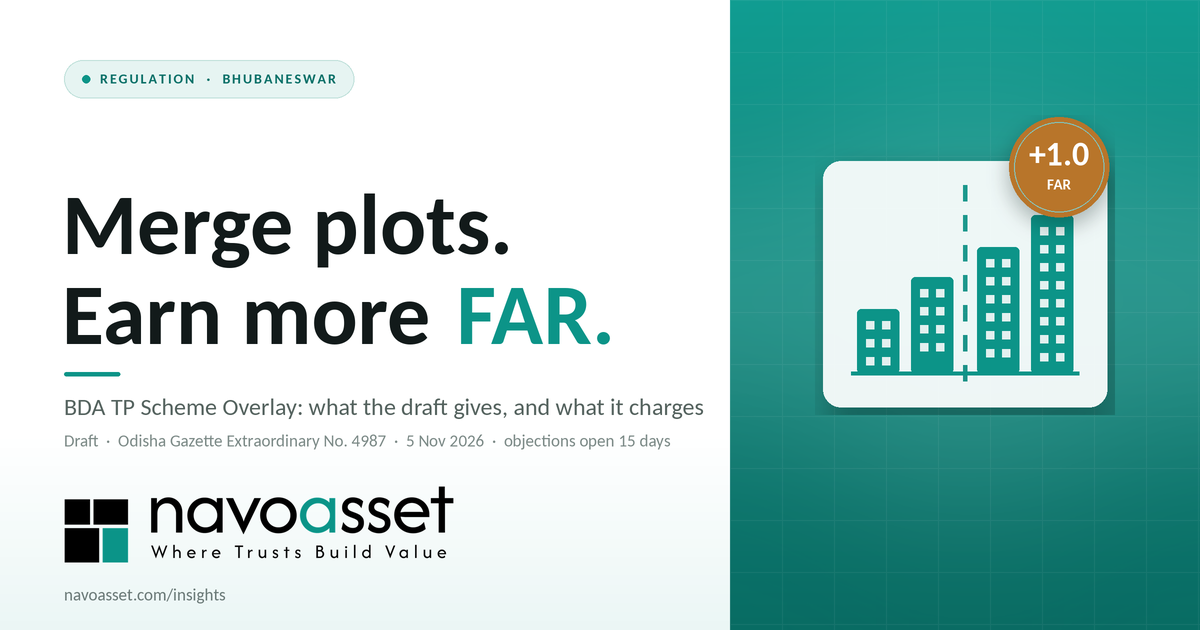
The Bhubaneswar Development Authority has published the draft BDA TP Scheme Overlay Regulations – formally the BDA (Planning and Building Standards) Second Amendment Regulations, 2026 – in the Odisha Gazette Extraordinary No. 4987 dated 5 November 2026, and posted it on bda.gov.in on 7 November 2026. The draft replaces the whole of Chapter IX (Regulations 77 to 79) of the BDA (Planning and Building Standards) Regulations, 2018 with a new chapter written specifically for Town Planning (TP) Schemes. It does two things: it rewards owners who merge their TP plots with extra FAR, and it introduces a City Infrastructure Impact Fee on developments outside a TP Scheme that connect to TP roads.
This is a draft under Sections 124 and 125 of the Odisha Development Authorities Act, 1982. Objections and suggestions go to the Secretary, BDA, and the draft will be taken up on or after the expiry of 15 days from publication in the Gazette – roughly 20 November 2026.
What the BDA TP Scheme Overlay Regulations propose
1. FAR incentive for voluntary amalgamation of TP plots (new Regulation 77)
Where two or more khatadars voluntarily amalgamate their original plots into a single final plot within a TP Scheme, the merged plot earns additional FAR over the base FAR, subject to the plot's maximum permissible FAR. The draft's Table 20A sets the bonus by the amalgamated area after the usual 40 per cent land deduction: more than 500 sq m and up to 1,000 sq m earns 0.5 FAR; more than 1,000 sq m earns 1.0 FAR.
To claim it, the owners execute a registered deed of agreement and file it within the window set by Rule 28(2) of the ODA Rules, 1983. An Authorised Officer (not below Deputy Secretary) then issues a FAR Incentive Certificate with a Utilisation Record (Form IVB) at the time of the Possession Order, and the entry is recorded in a public register (Form IVA) to be posted on the BDA website.
2. A certificate that travels with the plot (Regulations 77A to 77C)
The certificate is valid for ten years from notification of the final TP Scheme, extendable by the Authority on payment of a fee. It passes to later owners on sale, so a buyer of an amalgamated TP plot inherits the bonus if the seller produces the certificate. It lapses if the plot is later subdivided or the amalgamation is cancelled. The bonus can be drawn down at building-plan approval and in later additions until exhausted; base FAR is applied first, then the certificate, then any other permitted FAR route. Used FAR is not restored if the building is later altered or demolished. The register prevails over the certificate if the two disagree, and a forged certificate can lead to revocation of the approval.
3. Online management (Regulation 78)
BDA may run the certificates and register online and link them to the Online Building Plan Approval System, in which case an online-verifiable certificate needs no paper copy.
4. City Infrastructure Impact Fee (Regulation 79)
The CIIF applies to developments outside a TP Scheme boundary that take access from a TP road, directly or through a connecting road. Any intervening road must first be handed over free of cost to the local authority. For sub-divisional layouts the fee is 1 per cent of the plot's benchmark value multiplied by an infrastructure factor that rises with the width of the TP road used: 1.25 for roads up to 9 m, 1.50 up to 12 m, 1.75 up to 18 m, 2.00 up to 24 m, 2.25 up to 30 m and 2.50 above 30 m. For construction the fee is per square metre of built-up area: Rs 50 for plotted residential, Rs 60 for institutional and Rs 75 for apartments, commercial, industrial and all other uses. These rates rise 10 per cent on 1 April of every fifth year, starting 1 April 2032, without a fresh notification. A plot already charged at layout stage is not charged again at construction. Affordable housing under the Housing for All Policy 2022, non-commercial government projects, public utility infrastructure and any category BDA later notifies are exempt.
What this means for owners
If you hold a plot in any of BDA's TP Schemes – including the ten schemes notified earlier this year (see our guide to BDA Town Planning Schemes 2026) – a neighbour's willingness to merge plots now has a measurable value: a 0.5 or 1.0 FAR bonus that stays with the land for a decade and can be sold with it. Owners should check their final-plot area after the 40 per cent deduction, since the 500 sq m and 1,000 sq m thresholds decide the bonus. Owners of land just outside a TP Scheme that fronts a TP road should budget for the CIIF before approving a layout or building plan.
What this means for tenants
Nothing changes in an existing tenancy. Over time, amalgamated TP plots will support larger buildings, which is likely to bring more apartment and commercial stock to areas such as the TP Scheme belts around Bhubaneswar. Tenants in buildings outside TP Schemes may see the CIIF passed through in pricing of new projects, but it does not apply to existing buildings.
What Navoasset does
For owners we manage in or near TP Schemes, we track the final plot allotment, the Possession Order and any FAR Incentive Certificate, keep the certificate on the owner's document vault, and flag when a sale or building-plan application should carry it. NRI and away owners can send us their TP Scheme papers and we will tell them whether an amalgamation makes sense and what the CIIF exposure is before they commit to a layout.
This is a draft regulation and may change after the objection period. Figures are taken from the Gazette PDF published by BDA; confirm against the final notification before acting.